Over the years — including my time at Intel — I worked alongside highly capable people operating under constant pressure. Smart leaders. High performers. People carrying serious responsibilities. And one thing became increasingly clear to me:
The issue was rarely competence.
Most leaders already had the experience, intelligence, and technical capability required to perform at a high level.The challenge was something else entirely. It was the quiet accumulation of pressure over time.
The constant context switching.
The endless stream of decisions.
The expectation to always be “on.”
The lack of real recovery.
And eventually, without even realizing it, many leaders begin operating in a permanently reactive state. Not because they are weak. But because sustained pressure changes how we think, feel, and operate. That’s why I’ve become increasingly interested in mindset and self-coaching — not as abstract concepts, but as practical leadership skills.
Because in demanding environments, one of the most important capabilities we can develop is the ability to regulate ourselves. To notice when we are drifting into stress-driven thinking. To create moments of clarity before reacting. To reset our focus intentionally rather than operating on autopilot. Self-coaching is not about pretending everything is positive. It’s about awareness. It’s about learning to observe your internal state before it starts driving your behaviour unconsciously. The leaders who sustain high performance over the long term are rarely the loudest or most intense.
More often, they are the ones who can:
- stay grounded under pressure
- think clearly in complexity
- recover effectively
- create space before reacting
- lead themselves before leading others
That ability becomes even more important in today’s environment, where pressure is no longer occasional — it’s continuous. And this is where mindset matters. Not in the “motivational quote” sense. But in the deeper sense of: How do you speak to yourself under pressure?
How do you regain perspective? How do you reset when your energy is depleted?
How do you avoid becoming consumed by constant performance demands?
For me personally, this became an important shift. I stopped seeing resilience as simply “pushing harder.” Real resilience is more intelligent than that. It includes recovery.
Awareness. Presence. Reflection. And the ability to step back before pressure quietly erodes clarity and judgment. Ironically, slowing down briefly often allows leaders to perform far more effectively.
Not because they care less. But because they can think again.
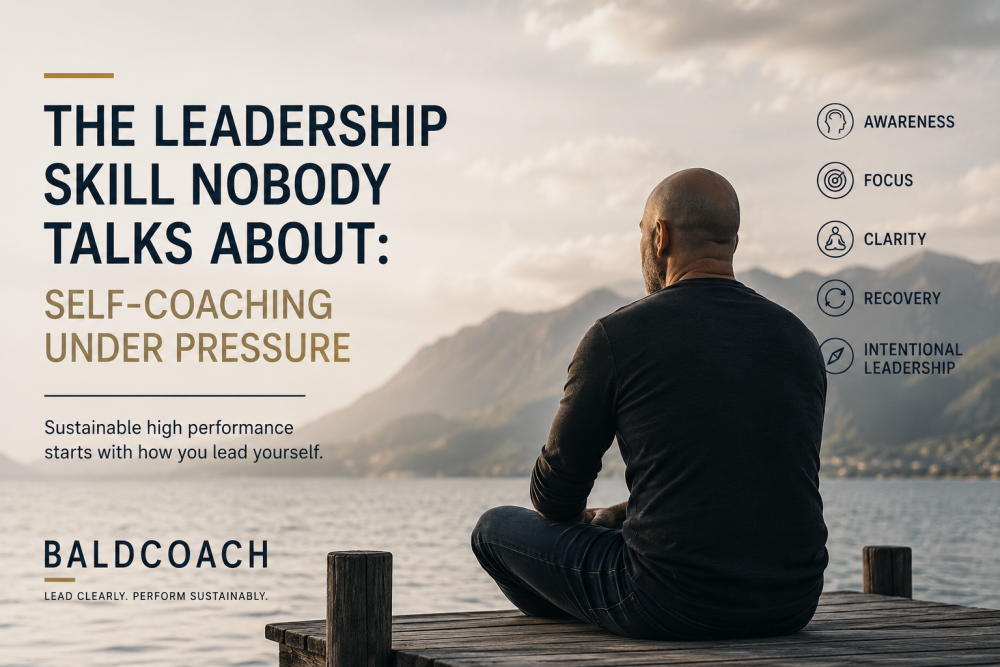
That’s also one of the reasons why I’m passionate about creating spaces where leaders can step outside the noise for a moment — to reconnect with clarity, focus, and intentional leadership. Because sustainable high performance is not built through constant acceleration It’s built through learning how to manage your inner state just as intentionally as you manage your external responsibilities. And ultimately, that may be one of the most important leadership skills of all. That’s also why I now offer workshops focused on leadership resilience, mindset, and sustainable high performance for leaders operating in demanding environments. If this topic resonates with you, feel free to check out the upcoming workshop dates and flyers below.